
Components and Architecture of DBMS
Learn about the major components of a DBMS, including hardware, software, data, users, the Query Processor, the Storage Manager, and how they work together.Components and Architecture of DBMS Explained

Introduction
A Database Management System (DBMS) is not just a single program that stores data. It consists of several components that work together to store, retrieve, process, protect, and manage information.
Whenever a user searches for a record, inserts new information, updates existing data, or deletes a record, different components of the DBMS work behind the scenes to complete that operation.
In this article, we will understand the major components of a DBMS, how they interact, and how a database system is organized.
1. Components of a Database System
A database system environment consists of several major components.
1.1 Hardware
Hardware refers to the physical devices on which the database system operates.
It includes:
- Computers and servers
- Storage devices such as SSDs and HDDs
- RAM
- Network devices
For example, an online banking database may be stored on powerful servers with high-speed storage and sufficient memory to handle thousands of requests.
1.2 Software
Software includes the programs used to manage and access the database.
The major software components include:
- DBMS software
- Operating system
- Database applications
- Utility programs
Examples of DBMS software include MySQL, PostgreSQL, Oracle Database, Microsoft SQL Server, and SQLite.
A DBMS provides the functionality required to interact with the database, while applications provide interfaces through which users perform their tasks.
1.3 Data
Data is the most important resource managed by a database system.
It includes:
- Actual stored records
- Metadata
- Indexes
- Transaction information
Metadata is data about data. It describes the structure of a database, such as table names, column names, data types, and constraints.
For example, a table containing student information may have the following structure:
| Column Name | Data Type |
|---|---|
| Student_ID | Integer |
| Name | Varchar |
| Age | Integer |
| Department | Varchar |
This structure is metadata, while the actual student records are the data.
1.4 Procedures
Procedures are instructions and rules for operating, maintaining, and managing a database system.
They may include:
- How to create and maintain databases
- How to take backups
- How to recover data after failures
- How to manage user accounts
- How to monitor database performance
Proper procedures help ensure that the database operates reliably and securely.
1.5 Database Access Language
A database access language allows users and applications to communicate with a database.
The most widely used database language is SQL (Structured Query Language).
SQL is used to perform operations such as:
- Creating tables
- Inserting records
- Retrieving information
- Updating data
- Deleting records
For example:
SELECT * FROM Students;This query requests all records from the Students table.
1.6 People or Users
Different people interact with a database system depending on their roles.
| User | Responsibility |
|---|---|
| Database Administrator (DBA) | Manages security, backups, performance, and maintenance |
| Database Designer | Designs database structure and relationships |
| Application Developer | Develops applications that interact with databases |
| End User | Uses applications to access or modify information |
For example, in a university database, the DBA maintains the system, developers build the university portal, and students and teachers use the portal to access information.
2. Internal Components of a DBMS
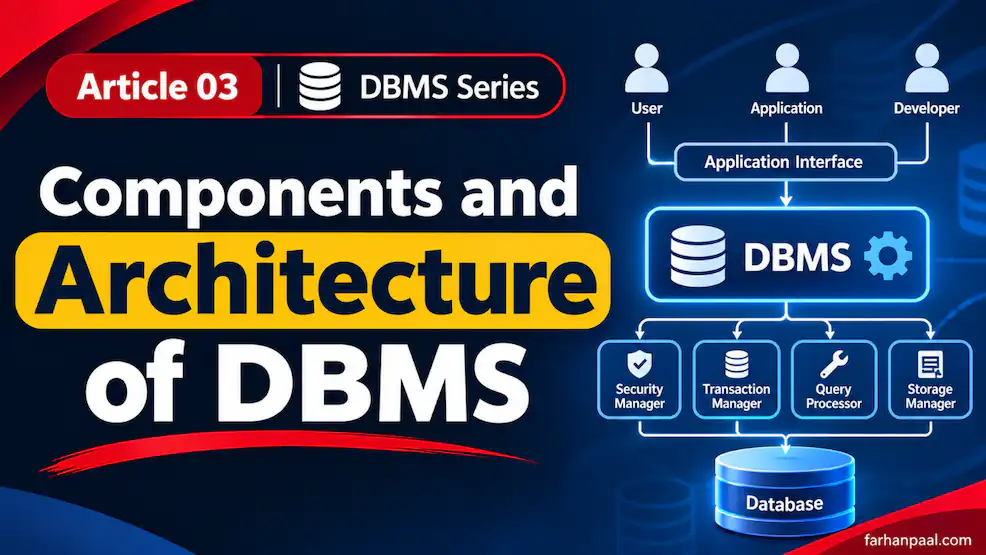
Inside the DBMS software, several components work together to process user requests.
<text color=”success” weight=”medium”>The two major functional areas are the Query Processor and the Storage Manager.</text>
2.1 Query Processor
The Query Processor handles database queries and determines how they should be executed.
When a user submits an SQL query, the Query Processor analyzes it, checks its validity, and prepares an efficient execution plan.
Its major parts include:
a. DDL Interpreter
Processes Data Definition Language (DDL) commands such as CREATE, ALTER, and DROP.
These commands are used to define or modify database structures.
b. DML Compiler
Processes Data Manipulation Language (DML) commands such as SELECT, INSERT, UPDATE, and DELETE.
It translates these commands into instructions that the DBMS can execute.
c. Query Optimizer
Examines possible ways to execute a query and selects an efficient execution strategy.
For example, when searching for a particular student among millions of records, the optimizer may choose to use an index instead of scanning every record.
d. Query Execution Engine
Executes the instructions produced by the query-processing components and interacts with other DBMS components to obtain or modify data.
2.2 Storage Manager
The Storage Manager is responsible for managing how data is stored, retrieved, and maintained on storage devices.
It acts as an interface between the DBMS and the data stored on disk.
Its major components include:
a. File Manager
Manages the allocation of disk space and the organization of database files.
b. Buffer Manager
Manages data temporarily stored in main memory (RAM).
Since accessing RAM is generally faster than accessing disk storage, the Buffer Manager helps improve performance by managing frequently needed data in memory.
c. Transaction Manager
Coordinates database transactions and helps maintain correctness when multiple operations are performed.
It supports reliable transaction execution and works with concurrency-control and recovery mechanisms.
d. Authorization and Integrity Manager
Checks user permissions and enforces integrity constraints to ensure that users perform only permitted operations and that data satisfies defined rules.
3. How These Components Work Together
Let’s understand the process using a simple example.
Suppose a student opens the university portal and searches for their examination result.
The following steps may take place:
- The student enters their roll number through the application.
- The application sends a database query to the DBMS.
- The Query Processor analyzes and prepares the query for execution.
- The Query Optimizer selects an efficient execution plan.
- The Query Execution Engine carries out the plan.
- The Storage Manager retrieves the required information from storage or memory.
- The DBMS returns the result to the application.
- The application displays the student’s result.
The components work together to make this process efficient, secure, and reliable.
4. Basic Architecture of a Database System
A simplified database system can be represented as:
          USERS / APPLICATIONS
                   |
                   v
          DATABASE INTERFACE
                   |
                   v
            QUERY PROCESSOR
                   |
                   v
            STORAGE MANAGER
                   |
                   v
          DATABASE STORAGE
This represents the general flow of a database request.
Users and applications send requests, the Query Processor interprets them, the Storage Manager handles data access, and the database storage contains the actual stored information.
Article in a Nutshell
A database system consists of hardware, software, data, procedures, database access languages, and users.
Internally, a DBMS mainly relies on the Query Processor and Storage Manager.
The Query Processor interprets, optimizes, and executes database queries, while the Storage Manager handles data storage, retrieval, memory management, transactions, and related operations.
Together, these components allow a DBMS to provide efficient, secure, and reliable access to data.
In the next article, we will explore the Three-Schema Architecture of DBMS and Data Independence, which explains how database structure is divided into different levels and how changes at one level can be isolated from others.
Quick quiz
5 questionsOriginally published at farhanpaal.com — https://farhanpaal.com/articles/components-and-architecture-of-dbms/
Keep a copy
Read offline as a printout or PDF.
farhanpaal.comKeep reading
Introduction to Database Management Systems
Learn what databases and DBMS are, why database management systems are needed, their real-world applications, and what this DBMS series covers.

Entity-Relationship Model: Entities, Attributes and Relationships
Learn the Entity-Relationship Model, including entities, attributes, relationships, attribute types, relationship degrees, cardinality, and ER diagram symbols.

Functional Dependencies and Attribute Closure
Learn functional dependencies, determinants, Armstrong's axioms, and attribute closure with step-by-step examples in DBMS.