
Conclusion: Your Journey Through Data Structures and Algorithms
Conclude your DSA journey with key lessons from 30 articles, the importance of practice, problem-solving, and what to learn next.


1. Looking Back at the Journey
Over the past 30 articles, we have explored one of the most fundamental areas of computer science: Data Structures and Algorithms.
We began with a simple question: How can we organize data and solve problems efficiently?
From there, we gradually explored different ways of storing, organizing, processing, searching, and connecting information.
We learned that choosing the right data structure can make a problem easier to solve, while choosing an efficient algorithm can significantly improve a program’s performance.
2. What We Have Learned
Throughout this series, we covered the following major topics:
| Area | Concepts Covered |
|---|---|
| Foundations | DSA, types of data structures, time and space complexity |
| Arrays | One-dimensional arrays, matrices, sparse matrices, strings |
| Linked Lists | Singly, doubly, and circular linked lists |
| Searching & Sorting | Linear search, binary search, bubble sort, selection sort, insertion sort, merge sort, quick sort |
| Linear Data Structures | Stacks, queues, circular queues, deques, priority queues |
| Advanced Structures | Heaps, recursion, trees, binary trees, AVL trees, threaded trees, M-way trees, B-Trees, B+ Trees |
| Graphs | Representations, BFS, DFS, MST, shortest paths, Eulerian and Hamiltonian tours |
| Hashing | Hash functions, direct addressing, collisions, chaining, probing, and rehashing |
These concepts are not isolated topics. They build upon one another and form the foundation of efficient programming and problem-solving.
3. Understanding Is More Important Than Memorization
Learning DSA is not about memorizing every algorithm or writing code without understanding it.
The real goal is to understand:
- Why a particular data structure is used.
- How an algorithm works step by step.
- What makes one solution more efficient than another.
- How to recognize which technique is suitable for a given problem.
- How to analyze the trade-offs between time, memory, and simplicity.
When you understand these ideas, solving unfamiliar problems becomes much easier.
4. The Importance of Practice
Reading about an algorithm is only the beginning.
To truly understand it, try implementing it yourself. Dry-run it using different inputs, explore edge cases, and compare its performance with alternative approaches.
When solving a problem, develop the habit of asking:
- What is the problem asking?
- What is the simplest possible solution?
- Can I improve its time complexity?
- Which data structure would help?
- What happens with unusual or extreme inputs?
Making mistakes is a natural part of learning. Debugging your own code, understanding why it failed, and correcting it are among the most valuable experiences in programming.
5. What Should You Study Next?
Completing this series gives you a strong foundation, but DSA is a subject that grows with practice.
You can continue by:
- Solving problems on platforms such as LeetCode, HackerRank, and Codeforces.
- Practicing problems according to topic and difficulty.
- Learning advanced graph algorithms.
- Exploring dynamic programming and greedy algorithms in greater depth.
- Studying advanced data structures.
- Applying DSA concepts to real software projects.
Start with easy problems, build confidence, and gradually increase the difficulty.
Consistency matters more than solving hundreds of problems in a single day.
6. DSA in Real Life
Data Structures and Algorithms are not just academic concepts.
They are used in search engines, operating systems, databases, social networks, navigation systems, artificial intelligence, recommendation systems, compilers, and almost every large software application.
Whenever software stores information, searches for something, processes data, makes decisions, or finds an efficient solution, the principles of DSA are often involved.
Understanding DSA helps you move beyond simply writing code that works. It helps you write code that works efficiently.
Final Words
Completing these 30 articles is an achievement, but it is only the beginning of your programming journey.
You now have a foundation to understand how data is organized and how problems can be solved efficiently. The next step is to apply this knowledge, experiment, practice, and build.
Don’t worry if you cannot remember every algorithm immediately. Return to the concepts whenever needed. Understanding grows through repetition and application.
Keep learning. Keep building. Keep solving.
And remember: the best programmer is not necessarily the one who knows the most algorithms, but the one who understands problems deeply and can find thoughtful, efficient solutions.
This concludes our DSA Series. Thank you for learning with us.
Originally published at farhanpaal.com — https://farhanpaal.com/articles/conclusion-your-journey-through-data-structures-and-algorithms/
Keep a copy
Read offline as a printout or PDF.
farhanpaal.comKeep reading
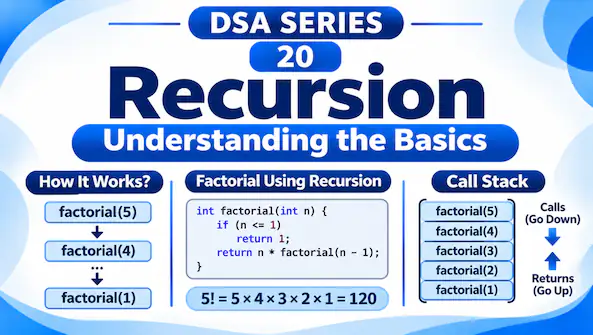
Recursion: Understanding the Basics
Understand recursion, base cases, recursive calls, and the call stack. Learn how to trace recursive functions and calculate factorial using simple C…
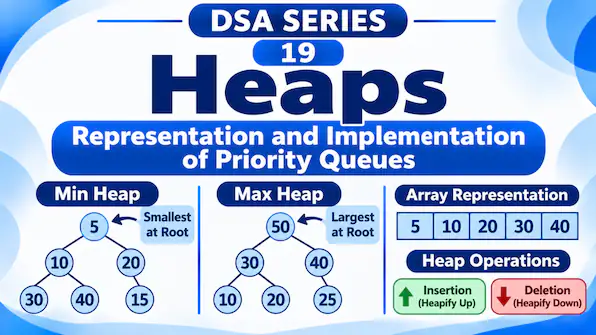
Heaps: Representation and Implementation of Priority Queues
Learn how Min Heaps and Max Heaps work, how Binary Heaps are represented using arrays, and how insertion and deletion maintain the…

Strings: Understanding String Data
Learn how strings work in C, including character storage, null termination, indexing, traversal, and common string functions with simple examples.