
Articles / Linear Algebra · Part 11
Real-World Applications of Linear Independence in Error Detection and Coding Theory
Understand how linear independence powers error detection and coding theory. Explore parity bits, linear codes, parity-check matrices, syndromes, and applications in communication and data storage.

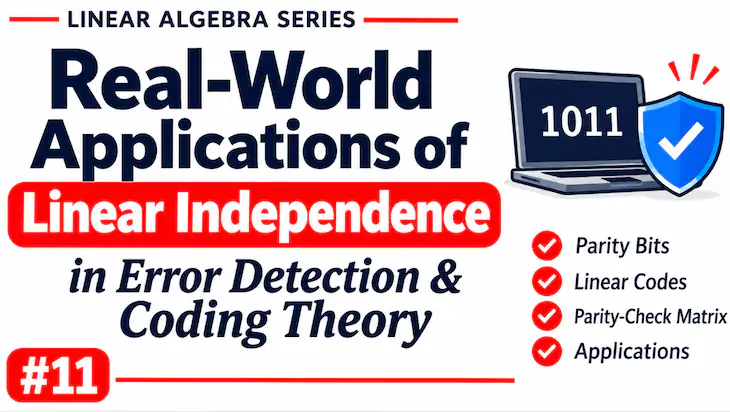
When we send data over the internet, store information on a computer, or communicate through satellites, the data may get corrupted.
A bit that was supposed to be 0 might become 1, or vice versa. Such errors can occur because of noise, interference, hardware problems, or transmission failures.
To detect these errors, computer systems use techniques from coding theory. One of the important mathematical ideas behind these techniques is linear independence.
Linear independence helps us construct reliable codes, detect errors, and sometimes correct them.
2. Why Do We Need Error Detection?
Suppose we want to send the binary message: 1011
During transmission, one bit changes because of noise: 1001
The receiver gets a different message without necessarily knowing that an error occurred.
To reduce this problem, we add extra bits called redundant bits. These bits do not carry new information directly; instead, they help verify whether the received message is correct.
This is the basic idea behind error detection.
3. What Is a Parity Bit?
A simple error-detection technique is called a parity check.
A parity bit is added to a binary message so that the total number of 1s becomes either even or odd, depending on the system.
Even parity
Suppose the message is: 1011
It contains three 1s, which is odd.
To make the total number of 1s even, we add a parity bit of 1.
The transmitted message becomes: 10111
Now the total number of 1s is four, which is even.
If one bit changes during transmission, the number of 1s becomes odd, and the receiver can detect an error.
4. Linear Algebra Behind Parity Checks
Parity checking can be represented using matrix multiplication over a special mathematical system called GF(2), or the Galois Field with two elements.
In GF(2):
- (0+0=0)
- (0+1=1)
- (1+0=1)
- (1+1=0)
Addition is equivalent to XOR in binary arithmetic.
Consider the message:
\[
\mathbf{x}=
\begin{bmatrix}
1\\
0\\
1\\
1
\end{bmatrix}
\]
We can check its parity using a matrix:
\[
H=
\begin{bmatrix}
1&1&1&1
\end{bmatrix}
\]
The received message is:
\[
\mathbf{r}=
\begin{bmatrix}
1\\
0\\
1\\
1
\end{bmatrix}
\]
The parity check is:
\[
H\mathbf{r}=1+0+1+1=1
\]
Since the result is (1), the parity condition is not satisfied.
If the message had an even number of ones, the result would be (0), indicating that the parity check passes.
5. What Is a Linear Code?
A linear code is a collection of valid codewords that form a vector space or subspace over a finite field.
Instead of sending the original message directly, we transform it into a longer codeword containing additional information.
For example, a message with three bits may be converted into a codeword with six bits.
These additional bits allow the receiver to check whether the received data satisfies certain mathematical conditions.
The code is designed so that valid codewords satisfy specific linear equations.
6. How Linear Independence Helps Build Reliable Codes
Linear independence is important when designing codes because it determines whether the constraints used in a code provide genuinely independent information.
If two constraints are dependent, one may be redundant.
For example:
\[
\mathbf{v}_1=
\begin{bmatrix}
1\
0\
1
\end{bmatrix},
\quad
\mathbf{v}_2=
\begin{bmatrix}
0\
1\
1
\end{bmatrix}
\]
These vectors are linearly independent because neither can be expressed as a scalar multiple of the other over GF(2).
They can provide two independent constraints on a system.
However, if we introduce:
\[
\mathbf{v}_3=
\begin{bmatrix}
1\
1\
0
\end{bmatrix}
\]
then:
\[
\mathbf{v}_3=\mathbf{v}_1+\mathbf{v}_2
\]
over GF(2).
Therefore, the third vector does not introduce a new independent direction.
This is important when designing efficient coding systems: independent constraints provide additional information, while dependent constraints may add redundancy without increasing the rank.
7. The Parity-Check Matrix
A parity-check matrix, usually represented by (H), is used to verify whether a received codeword satisfies the rules of a code.
For a valid codeword \(\mathbf{c}\):
\[
H\mathbf{c}=\mathbf{0}
\]
If the received vector is \(\mathbf{r}\), we calculate:
\[
\mathbf{s}=H\mathbf{r}
\]
The vector \(\mathbf{s}\) is called the syndrome.
- If \(\mathbf{s}=\mathbf{0}\), the received message passes the parity checks.
- If \(\mathbf{s}\neq\mathbf{0}\), an error has been detected.
The syndrome provides information about the error and can help locate it in some coding systems.
8. A Simple Example
Suppose we have a parity-check matrix:
\[
H=
\begin{bmatrix}
1&1&0\\
0&1&1
\end{bmatrix}
\]
A received vector is:
\[
\mathbf{r}=
\begin{bmatrix}
1\\
0\\
1
\end{bmatrix}
\]
Calculate:
\[
\begin{bmatrix}
1&1&0\\
0&1&1
\end{bmatrix}
\begin{bmatrix}
1\\
0\\
1
\end{bmatrix}
\]
Over GF(2):
\[
\begin{bmatrix}
1\\
1
\end{bmatrix}
\]
Since the syndrome is nonzero, the received vector does not satisfy the parity-check conditions.
An error has been detected.
9. Applications in the Real World
Linear independence and coding theory are used in many technologies.
Data storage
Hard drives, SSDs, and memory systems use error-detection and error-correction techniques to protect stored information.
Communication systems
Mobile networks, Wi-Fi, satellite communication, and digital broadcasting use coding techniques to handle errors caused by noise.
QR codes
QR codes contain redundant information that allows them to remain readable even when some portions are damaged or obscured.
Space communication
Signals sent over enormous distances, such as from spacecraft, require powerful error-correction methods because retransmission may be difficult or impossible.
Computer memory
Error-correcting memory (ECC RAM) can detect and correct certain memory errors, helping maintain data integrity.
Linear independence helps us understand how many genuinely independent constraints exist in a coding system.
Coding theory uses mathematical structures to add redundancy to data so that errors can be detected or corrected.
Key concepts:
- Parity bits add simple redundancy to detect errors.
- Linear codes use mathematical structures to represent valid messages.
- Parity-check matrices verify codewords.
- Syndromes help detect errors.
- Linear independence determines whether constraints provide independent information.
- Rank helps measure the number of independent constraints in a coding system.
Linear algebra is therefore not just theoretical mathematics. It is one of the foundations of reliable digital communication and data storage.
Quick quiz
5 questionsOriginally published at farhanpaal.com — https://farhanpaal.com/articles/real-world-applications-of-linear-independence-in-error-detection-and-coding-theory/
Keep a copy
Read offline as a printout or PDF.
farhanpaal.comKeep reading
Rank-Nullity Theorem: Row Space, Column Space, and Null Space
Understand rank, nullity, row space, column space, and null space through simple matrix examples. Learn how row reduction reveals independent directions and…

Matrix Factorization: LU Decomposition for Solving Systems
Learn LU decomposition, factor matrices into lower and upper triangular forms, and solve systems of linear equations using forward and backward substitution.

Matrix Factorization: QR Decomposition for Least Squares Problems
Learn QR decomposition, orthogonal matrices, Gram-Schmidt, and how QR factorization solves least squares problems step by step.