
 Farhan Paal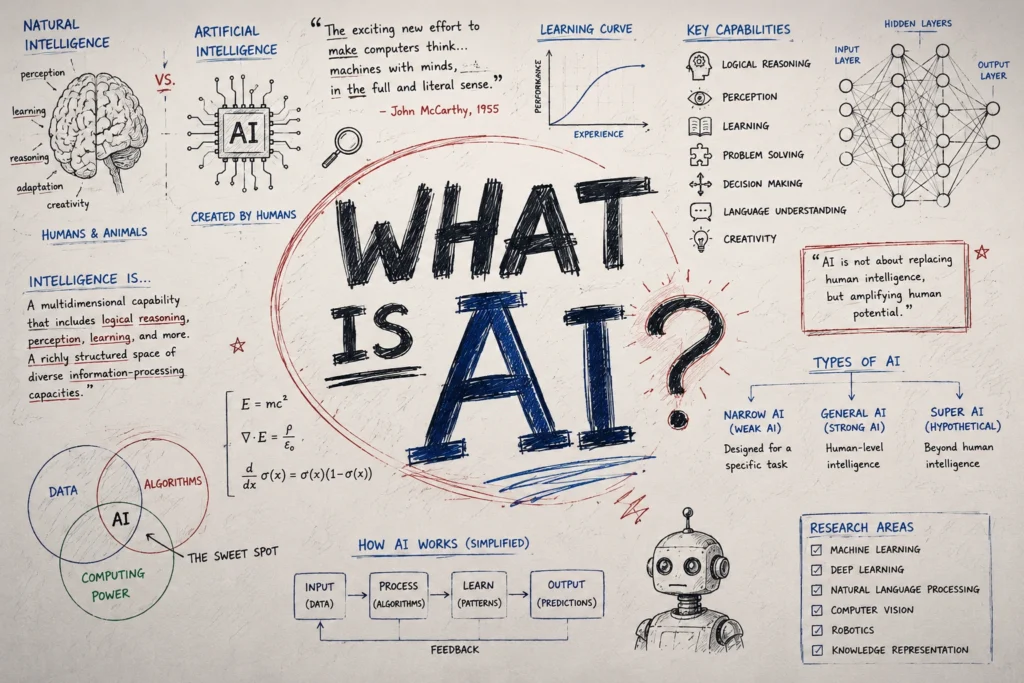
Artificial Intelligence (AI) is the ability of a machine or computer system to perform tasks that normally require human intelligence.
AI is a hot topic of the second quarter of the 21st century; everyone talks about it. Some say it is good, and some say it’s destructive. That’s the topic for another day. In this article, you will learn the concept of AI in a detailed form.
Mainly, there are two intelligences on the planet: natural and artificial intelligence. Natural intelligence includes the intelligence of humans and animals, and artificial intelligence is the intelligence created by humans. Now the question is, what does INTELLIGENCE mean?
Intelligence is a multidimensional concept that includes logical reasoning, perception, learning, prediction, planning etc. It is a richly structured space of diverse information-processing capacities.
The term ‘Artificial Intelligence‘ was coined by computer scientist John McCarthy in 1955 in the proposal for the Dartmouth Summer Research Project on Artificial Intelligence.
The Dartmouth Project: Where AI Became a Field
Before Artificial Intelligence became the massive field we know today, it was simply an ambitious question: Can machines think?
In 1955, computer scientist John McCarthy and other researchers prepared a proposal for a summer research project at Dartmouth College in New Hampshire, USA. This proposal was written by John McCarthy, Marvin Minsky, Nathaniel Rochester, and Claude Shannon. It proposed a summer research project to explore the possibility of creating intelligent machines.
The proposal brought together researchers interested in exploring whether machines could perform tasks normally associated with human intelligence.
The proposal suggested a two-month research project based on a simple but ambitious idea:
Can human intelligence be described precisely enough that a machine can simulate it?
The following year, in the summer of 1956, the proposed research project actually took place. It became known as the Dartmouth Summer Research Project on Artificial Intelligence, often referred to as the Dartmouth Conference.
It was different from a typical conference that lasts for a day or two. The project continued for around two months (June 18 to August 17), with researchers joining and leaving at different times. Around 20 scientists participated overall.
Their main goal was to explore whether machines could perform activities that we normally associate with human intelligence. They discussed areas such as:
- Reasoning and problem-solving
- Learning from experience
- Using language
- Forming concepts and abstractions
- Improving the performance of machines
The researchers did not create a machine with human-level intelligence, nor did they find a final solution to the problem of intelligence. There was no moment at the end of the project where they announced that they had solved AI.
However, the project achieved something historically important. It brought researchers working on machine intelligence together under a common idea and, more importantly, under a common name: Artificial Intelligence.
For this reason, the Dartmouth Project is widely considered one of the foundational events in the history of AI. It did not create modern AI overnight, but it helped transform the idea of intelligent machines into a distinct field of research.
Approaches to Artificial Intelligence
Before discussing the different approaches to AI, it is important to understand what the word “approach” means here.
An approach to AI is a particular way of trying to create, model, or understand intelligent behavior in machines. Different researchers have taken different paths toward building intelligent systems. Some have focused on rules and logic, while others have focused on learning from data, evolution, interactions between simple components, or how behavior changes over time.
These approaches are sometimes described as computational paradigms. A paradigm is a general framework or way of thinking about how a problem should be approached or solved. Therefore, a computational paradigm is a particular way of thinking about how computation can be used to solve problems or produce intelligent behavior.
These approaches should not be confused with types of AI. Instead, AI can be classified in different ways depending on what we are trying to describe.
For example, AI can be classified by its capabilities, such as:
- Artificial Narrow Intelligence (ANI): designed to perform specific tasks.
- Artificial General Intelligence (AGI): a hypothetical form of AI capable of performing a broad range of intellectual tasks at a human-like level.
- Artificial Superintelligence (ASI): a hypothetical form of AI that would surpass human intelligence across a wide range of intellectual abilities.
The approaches discussed below are different. They describe how researchers have attempted to build or model intelligence computationally.
The following approaches are not all used as mainstream AI architectures today. Some, such as cellular automata and dynamical systems, have influenced areas such as artificial life, robotics, complex-systems research, and computational modeling.
Several important approaches and computational paradigms have contributed to the development of AI:
- Classical AI (GOFAI)
- Artificial Neural Networks (Connectionism)
- Evolutionary Computation
- Cellular Automata
- Dynamical Systems
1. Classical AI (GOFAI)
GOFAI, or Good Old-Fashioned Artificial Intelligence, refers to AI systems based primarily on explicit rules, logic, symbols, knowledge representation, and programmed reasoning. These systems attempt to solve problems by manipulating symbols according to predefined rules.
-
The Core Idea: Intelligence is modeled through explicit rules, logic, symbols, and structured knowledge.
-
How It Works: Humans program the exact rules and knowledge into the computer (“If X happens, do Y”). The computer then uses formal logic to reason through problems.
-
Example: Chess-playing systems such as Deep Blue, which used extensive search and human-designed evaluation methods to analyze possible moves, or traditional expert systems that relied on explicit rules and knowledge.
-
Key Advantage: Transparent and easy to explain, you can trace every step of the decision.
-
Main Limitation: Struggles with real-world messiness, ambiguity, and complex sensory data (e.g., recognizing a blurry photo of a cat).
2. Artificial Neural Networks (Connectionism)
Connectionism is an approach to AI inspired by the way biological neurons are interconnected. Artificial neural networks consist of interconnected computational units that learn patterns from data. Modern deep learning is largely based on this approach.
-
The Core Idea: Intelligence comes from interconnected networks, loosely inspired by how biological neurons fire together in the human brain.
-
How It Works: Instead of being given explicit rules, the network learns patterns from data by adjusting the strengths of its internal connections, called weights, during training.
-
Example: Modern deep-learning systems such as ChatGPT, image-generation systems, facial-recognition systems, and speech-recognition systems.
-
Key Advantage: Exceptionally strong at handling unstructured data like images, natural speech, and unstructured text.
-
Main Limitation: Often difficult to interpret; it can be challenging to determine exactly why a neural network produced a particular decision or prediction.
3. Evolutionary Computation
Evolutionary computation takes inspiration from biological evolution. Algorithms in this family use mechanisms such as selection, mutation, and reproduction to search for effective solutions to complex problems. Genetic algorithms are a well-known example.
-
The Core Idea: Intelligence can be evolved over time using principles from natural selection and genetics.
-
How It Works: The system creates a “population” of hundreds of candidate solutions to a problem, tests how well each performs (fitness test), keeps the best ones, and combines/mutates them to generate a stronger next generation.
-
Example: Optimizing complex logistics schedules, designing aerodynamic shapes (like specialized NASA antenna designs), or financial portfolio optimization.
-
Key Advantage: Excellent for finding high-performing solutions to massive, non-traditional design and optimization problems where humans wouldn’t know where to start.
-
Main Limitation: Can be computationally slow because thousands of generations must be simulated.
4. Cellular Automata
Cellular automata are computational systems made up of interconnected cells, where each cell changes its state according to a set of rules and the states of neighboring cells. They can be used to model complex systems and have influenced research in artificial life and computation.
-
The Core Idea: Extremely complex global patterns and behaviors can emerge from simple local rules.
-
How It Works: Picture a grid of pixels (cells). Each cell checks only its immediate neighbors and changes its state (on/off, live/dead) based on simple rules. No central brain directs the grid, yet intricate patterns and structures form across the entire system.
-
Example: Conway’s Game of Life, modeling crowd movements, simulating forest fire spread, or modeling urban expansion.
-
Key Advantage: Demonstrates how complex real-world phenomena arise from very simple localized interactions.
-
Main Limitation: Hard to harness to perform specific goal-oriented tasks like writing a summary or diagnosing a disease.
5. Dynamical Systems
The dynamical systems approach represents intelligent behavior as the result of interactions and changes within a system over time. It focuses on how an agent, its environment, and their interactions evolve dynamically rather than treating intelligence solely as symbolic reasoning or information processing.
-
The Core Idea: The dynamical-systems perspective emphasizes that intelligence is not necessarily just internal information processing; it can emerge from ongoing interactions between an agent, its body, and its environment.
-
How It Works: Rather than translating sensory inputs into internal symbols or static data, the system models real-time movement and adaptation using mathematical models, differential equations where appropriate, and feedback loops.
-
Example: Robotic control systems, such as those used in advanced robots for maintaining balance, navigating terrain, and adapting movement to changing environments.
-
Key Advantage: Highly effective for real-time physical navigation, dynamic balance, and movement in unpredictable physical environments.
-
Main Limitation: Less suited for abstract cognitive tasks like translation or logical theorem proving.