 Farhan Paal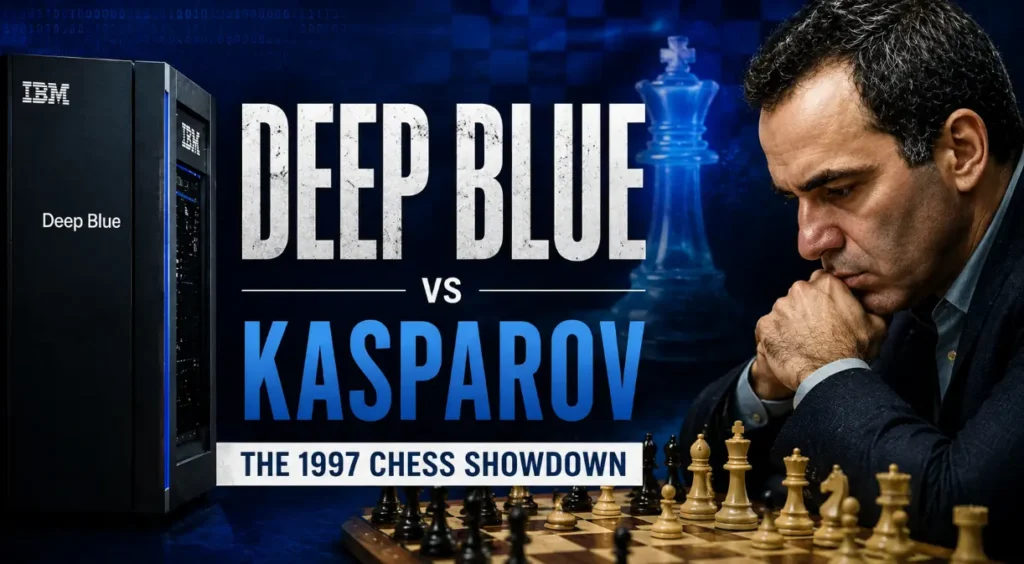
In 1997, a machine did something that had once seemed almost impossible: it defeated the reigning world chess champion.
The machine was IBM Deep Blue, a chess-playing supercomputer developed by IBM. Its opponent was Garry Kasparov, one of the greatest chess players in history and the reigning World Chess Champion.
But Deep Blue did not appear out of nowhere.
Long before Deep Blue defeated Kasparov, researchers had already been exploring whether computers could perform tasks that required human intelligence. In fact, computer chess itself had been studied since the early days of computing. In 1950, mathematician Claude Shannon published influential ideas about how a computer could play chess, and in the following decades researchers developed increasingly sophisticated chess programs.
One important milestone came in the 1980s with ChipTest, a chess machine developed at Carnegie Mellon University by Feng-hsiung Hsu and his colleagues. ChipTest was later developed into Deep Thought, which became one of the strongest chess-playing computers of its time. In 1989, Deep Thought even defeated grandmaster Benton Cook in a tournament game.
Feng-hsiung Hsu and Murray Campbell later joined IBM, where they continued developing their chess technology. Their work eventually led to Deep Blue.
So Deep Blue was not the first attempt to make a machine play chess. Rather, it was the result of decades of research in artificial intelligence, computer chess, algorithms and high-performance computing.
And that is what makes its 1997 victory so important.
Deep Blue demonstrated that a machine could outperform the reigning world chess champion in a highly complex strategic game. It was a major milestone in the history of AI and computing.
However, Deep Blue was very different from the AI systems we use today, such as ChatGPT, Gemini, and Claude.
Deep Blue was a specialized AI system. It was built specifically to play chess. It did not have a general understanding of language or the world, and it could not write essays, hold conversations, generate images, or perform the wide range of tasks that modern AI systems can perform.
Its strength came primarily from specialized chess algorithms, enormous computational power, parallel processing, search techniques, evaluation functions, and extensive chess knowledge.
This raises an important question:
How did a machine designed specifically for chess become capable of defeating one of the greatest chess players in history?
To understand that, we first need to understand what Deep Blue was, how it worked, and how it evolved from the earlier generation of computer-chess systems.
What Was IBM Deep Blue?
IBM Deep Blue was a specialized chess-playing supercomputer developed by IBM.
Its purpose was very specific: play chess at an extremely high level and eventually defeat the world’s strongest human chess player.
Deep Blue evolved from earlier chess-playing systems developed by researchers including Feng-hsiung Hsu and Murray Campbell. Their earlier project, Deep Thought, had already demonstrated that computers could play chess at a high level. Hsu and Campbell joined IBM Research in 1989, where they continued developing increasingly powerful chess machines.
The name Deep Blue was a play on IBM’s nickname, “Big Blue.”
Deep Blue wasn’t a general-purpose AI assistant. It was essentially a highly specialized machine built around one problem:
How can a computer calculate and evaluate chess positions well enough to beat the strongest humans?
Why Was Chess Such an Important Test for AI?
Chess has long been used as a test of machine intelligence.
The rules are relatively simple compared with many real-world problems, but the number of possible games is enormous. IBM notes that chess has approximately 10⁴⁰ possible legal moves/games configurations, illustrating the enormous search space a computer must deal with.
A human grandmaster doesn’t calculate every possible move. Instead, players use experience, pattern recognition, strategic principles and intuition to focus on promising possibilities.
Computers approached the problem differently.
They could:
- Generate possible moves.
- Calculate resulting positions.
- Search deeper into possible sequences.
- Evaluate those positions.
- Compare alternatives.
- Choose the move with the best calculated outcome.
The challenge was to make the machine fast enough and smart enough to search an enormous number of possibilities within the limited time of a tournament game.
The Road to Deep Blue
Deep Blue did not appear suddenly in 1997. IBM had been working on computer chess for decades.
In 1957, IBM engineer and mathematician Alex Bernstein created an early complete computer chess program that ran on an IBM 704. It could process around 42,000 instructions per second.
During the following decades, computer chess gradually improved.
By the 1980s, researchers were developing much stronger chess machines. One particularly important project was ChipTest, developed at Carnegie Mellon University by Feng-hsiung Hsu and others. ChipTest later evolved into Deep Thought, which became the first program to defeat a grandmaster.
Then came IBM.
Hsu and Campbell joined IBM Research in 1989 and continued their work toward building a machine capable of challenging the world’s best chess player.
That project eventually became Deep Blue.
How Did Deep Blue Work?
This is perhaps the most important part of understanding Deep Blue. Deep Blue wasn’t simply “thinking” about chess in the same way a human does. Its power came from several technologies working together.
1. Massive Search
Deep Blue could examine an extraordinary number of possible chess positions.
IBM reports that the 1997 version could evaluate approximately 200 million chess positions per second.
That enormous calculation rate allowed it to explore possibilities far beyond what a human could calculate directly.
Imagine a player considering:
“If I move my knight here, what can my opponent do?”
The opponent may have dozens of possible responses. Each response creates another set of possibilities.
Deep Blue could rapidly explore huge portions of this tree of possibilities.
2. Parallel Processing
Deep Blue used 32 processors working together in parallel. IBM reports a processing speed of approximately 11.38 billion floating-point operations per second.
Parallel processing was crucial.
Instead of having one processor perform every calculation sequentially, Deep Blue could divide computational work across multiple processing units.
This made it possible to analyze enormous numbers of chess positions in a short period.
3. Specialized Chess Chips
Deep Blue wasn’t just a normal computer running a chess program.
Its architecture included specialized chess hardware.
IBM Research reports that the Deep Blue supercomputer that defeated Kasparov used 480 custom chess chips, which provided much of its computational power.
This is an important difference between Deep Blue and modern AI systems.
Deep Blue was hardware and software designed specifically for chess.
4. Evaluation Functions
Searching millions of positions isn’t enough.
The computer also needs to determine:
Which position is better?
Deep Blue therefore used a sophisticated evaluation function.
It could assign value to characteristics of a chess position, such as material balance, king safety, pawn structure, piece activity and other strategic factors.
For example:
- A queen is generally worth more than a rook.
- A rook is generally worth more than a bishop or knight.
- A strong king position can be valuable.
- Controlling important squares can matter.
- Certain pawn structures can be advantageous.
These principles were incorporated into the system’s evaluation process.
IBM Research describes Deep Blue’s success as resulting from several factors, including its chess search engine, massively parallel architecture, search extensions, complex evaluation function and use of a grandmaster game database.
Deep Blue Had Chess Knowledge Too
Deep Blue wasn’t simply blindly calculating random moves. Its developers incorporated extensive chess knowledge into the system. It had access to databases of grandmaster games and used this information alongside its search and evaluation mechanisms.
This allowed the system to recognize and evaluate chess situations more effectively.
In other words:
Deep Blue combined computational brute force with human-designed chess knowledge.
That combination was extremely powerful.
Deep Blue vs Garry Kasparov: 1996
Before the historic victory, Deep Blue had already played Kasparov.
The first major match took place in February 1996.
Kasparov was the reigning World Chess Champion.
Deep Blue managed to achieve something remarkable: it defeated Kasparov in the first game, becoming the first computer to beat a reigning world champion in a game under standard tournament conditions. But Deep Blue did not win the match.
Kasparov recovered and defeated the machine 4–2 over the six-game match.
The result showed two things simultaneously:
Computers were becoming incredibly strong at chess.
But: The world’s best human was still stronger overall.
IBM wasn’t satisfied. The team began improving Deep Blue.
How IBM Improved Deep Blue
After the 1996 match, IBM researchers upgraded the system.
According to IBM, the improvements included:
- Better chess endgame databases
- A more powerful evaluation function
- Advice from additional chess grandmasters
- Improved methods for handling and disguising the computer’s strategy
The goal was simple:
Come back stronger.
And the rematch would become one of the most famous human-versus-machine competitions in history.
Deep Blue vs Kasparov: 1997
In May 1997, Deep Blue and Garry Kasparov met again in New York. This time, the stakes were enormous. The world was watching.
The question wasn’t simply:
“Can a computer play chess?”
That had already been answered.
The question was: “Can a machine actually defeat the reigning world chess champion in a full match?”
The answer would be yes.
The 1997 Match
The six-game match produced an extremely close result.
| Game | Result |
|---|---|
| Game 1 | Kasparov won |
| Game 2 | Deep Blue won |
| Game 3 | Draw |
| Game 4 | Draw |
| Game 5 | Draw |
| Game 6 | Deep Blue won |
Final score:
Deep Blue : 3.5
Kasparov : 2.5
Deep Blue therefore won the match.
The Historic Sixth Game
The sixth game became particularly famous.
Before Game 6, the match was tied 2.5–2.5.
That meant the final game would determine the winner.
Deep Blue won.
Kasparov resigned after Deep Blue’s play left him in a losing position, giving IBM’s machine the match victory.
The result was historic.
For the first time, a computer system had defeated a reigning world chess champion in a match under standard tournament time controls.
Why Was Deep Blue’s Victory So Important?
Deep Blue’s victory became a symbolic moment in the history of computing.
For decades, chess had been considered a particularly challenging demonstration of human intelligence.
Humans could understand strategy, recognize patterns and plan far ahead.
Yet a machine had now demonstrated that specialized computation could outperform the world’s best human player in an intellectually demanding domain.
IBM itself describes the event as an inflection point in computing and AI.
But there’s an important qualification.
Deep Blue did not prove that machines had become generally intelligent.
It proved something narrower but still remarkable:
A sufficiently powerful computer, combined with specialized algorithms and domain knowledge, could outperform humans at a complex strategic task.
Was Deep Blue Actually Thinking?
This is where things become philosophically interesting.
When Deep Blue defeated Kasparov, people naturally asked:
“Did the computer actually understand chess?”
The answer depends on what we mean by “understand.” Deep Blue didn’t possess human consciousness. It didn’t have emotions. It didn’t experience pressure. It didn’t understand the meaning of victory.
It didn’t sit at the board thinking:
“Kasparov is attacking my king, so I should change my strategy.”
Instead, it performed enormous amounts of computation according to its programming and hardware architecture. It searched possible moves and evaluated resulting positions.
Therefore, Deep Blue’s victory shouldn’t be interpreted as proof that the machine thought like a human.
It demonstrated that a machine could achieve superhuman performance in a specific task using a fundamentally different approach.
Deep Blue Wasn’t Like ChatGPT
This distinction is extremely important when studying AI history. Today, people often use the word “AI” to describe systems such as ChatGPT, Gemini and Claude. But Deep Blue worked very differently.
Deep Blue
Input: Chess position
Processing: Search millions of possible positions + chess evaluation
Output: Chess move
Modern generative AI
Input: Text, image, audio or other data
Processing: Neural networks trained on enormous datasets
Output: Generated text, images, code, audio or other content
Deep Blue was highly specialized.
Modern foundation models are designed to be much more general-purpose. That’s why Deep Blue should be understood as an important stage in AI’s evolution rather than as a direct predecessor to today’s large language models.
Was Deep Blue Machine Learning?
This is another common misconception.
Deep Blue was not a modern machine-learning system.
Its success relied heavily on:
- Search algorithms
- Hand-designed evaluation functions
- Specialized hardware
- Parallel computing
- Chess databases
- Human chess knowledge
IBM Research specifically describes its architecture in terms of a chess search engine, parallelism, search extensions, an evaluation function and grandmaster databases. Modern AI systems often work very differently.
For example, neural networks can learn statistical patterns from enormous datasets during training. Deep Blue was much more engineered for its specific task.
Deep Blue vs Modern Chess Engines
Interestingly, Deep Blue is no longer considered the strongest approach to computer chess. Modern chess engines have become extraordinarily powerful.
Systems such as Stockfish (a powerful open-source chess engine that uses advanced search algorithms to analyze chess positions) use advanced algorithms and modern hardware, while neural-network-based systems such as AlphaZero (a DeepMind AI system that learned to play chess through neural-network training and self-play) demonstrated another approach to achieving superhuman chess performance.
This progression illustrates something important about AI:
The methods used to achieve machine intelligence can change dramatically over time.
Deep Blue showed the power of search + computation.
Later systems demonstrated the power of machine learning + neural networks.
What Happened to Deep Blue?
After its historic victory over Kasparov, Deep Blue was retired.
IBM says the machine was subsequently retired to the Smithsonian Museum in Washington, D.C.
But its technological legacy continued. IBM went on to develop other large-scale computing systems, including Blue Gene, and later Watson, which became famous for defeating human champions on Jeopardy! in 2011.
This creates an interesting sequence in IBM’s AI history:
Deep Blue → Watson → modern IBM AI
Each represented a different kind of machine capability.
What Did Deep Blue Teach the World?
Deep Blue’s greatest contribution wasn’t simply winning a chess match. It demonstrated the enormous potential of specialized high-performance computing.
The technologies and ideas associated with Deep Blue contributed to broader work involving large-scale computation and complex problem-solving. IBM has described applications and lessons extending into areas such as financial modeling, data mining, genomics and pharmaceutical research.
The larger lesson was powerful:
A machine doesn’t necessarily have to solve a problem the way a human does in order to outperform a human at it.
Humans use intuition, experience and pattern recognition. Deep Blue used computational scale, search and specialized knowledge. Different methods can reach the same goal.
The Real Legacy of IBM Deep Blue
Deep Blue’s 1997 victory didn’t mean that computers had become human. It demonstrated something more interesting.
Machines didn’t need to imitate human intelligence perfectly to surpass humans at particular intellectual tasks.
Deep Blue approached chess differently from a human.
- It calculated enormous numbers of positions.
- It used specialized hardware.
- It incorporated human chess knowledge.
- It searched possibilities at a speed no human could match.
- And ultimately, that was enough to defeat the strongest human chess player in the world.
Today, we take it for granted that computers can beat humans at chess. But in 1997, that boundary had just been crossed.
Deep Blue helped change the question from:
“Can a computer ever beat a human at something as complex as chess?”
to:
“What other intellectual tasks can machines eventually outperform humans at?”
That question remains at the heart of artificial intelligence today.
IBM Deep Blue demonstrated that machines could outperform humans at extraordinarily complex tasks, even when they approached those tasks in a completely different way.
And its story is an important chapter in the much larger story of AI:
- Deep Blue calculated chess positions (a specialized IBM supercomputer that analyzed millions of possible chess moves to defeat Garry Kasparov).
- Watson understood natural-language questions (an IBM AI system that analyzed human-language questions and information to find and provide answers).
- Modern AI generates, reasons, analyzes and interacts across many domains.
The journey from Deep Blue to today’s AI is a story of how machines went from solving highly specialized problems to becoming increasingly general-purpose systems.
Sources
This article is based primarily on IBM’s historical and research material on Deep Blue, including IBM’s official Deep Blue history and IBM Research publications.
IBM : Deep Blue history
IBM Research : Deep Blue
IBM : History of Artificial Intelligence