 Farhan Paal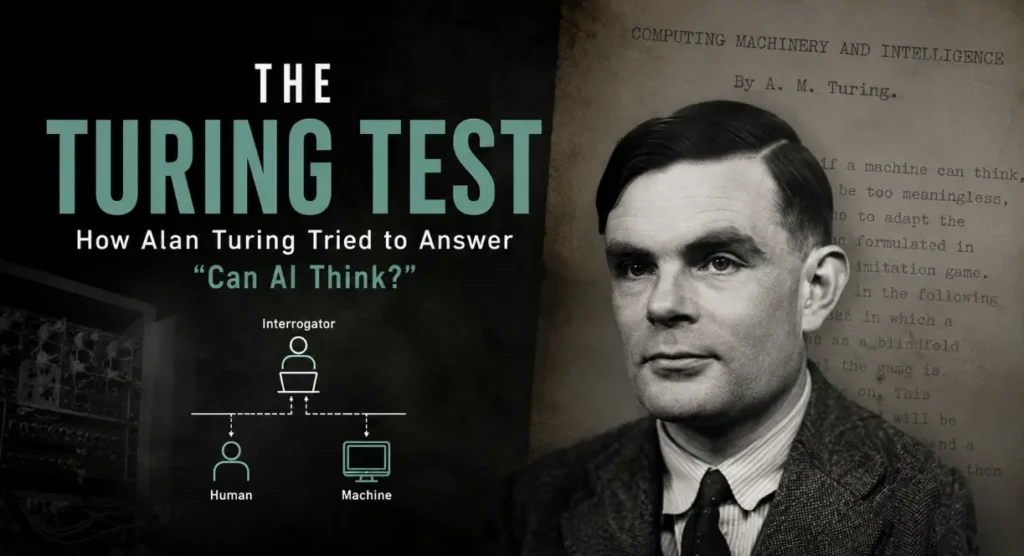
In 1950, long before ChatGPT, smartphones, or even artificial intelligence had become an established field of study, a British mathematician named Alan Turing asked a simple question: “Can machines think?
It sounds like a question that should have a straightforward answer. A machine either thinks or it doesn’t. But there was a problem. Nobody could easily agree on what thinking actually meant, or how we could prove that a machine was doing it.
Turing found a clever way around this problem. Instead of spending his time trying to define exactly what it means for a machine to “think,” he proposed a practical test based on something humans do every day: conversation.
His idea was introduced in his famous 1950 paper, Computing Machinery and Intelligence, published in the philosophical journal Mind. The paper would go on to become one of the most influential works in the history of artificial intelligence.
Today, Turing’s idea is known as the Turing Test.
But what exactly is the test? Why did Turing invent it? And if a machine can convince us that it is human, does that really mean it can think?
To understand the Turing Test, we first need to go back to the beginning.
Turing began his paper with the question: “Can machines think?”
It was a bold question for 1950. Computers were still in their infancy, and electronic computing machines were nothing like the AI systems we interact with today. But Turing quickly pointed out a difficulty with the question itself.
What does machine mean? And more importantly, what does think mean?
If two people disagree about the meaning of “thinking,” then simply arguing about whether a machine can think will not get us very far.
Rather than getting stuck on the definition of “thinking,” Turing proposed a different way of approaching the problem: test whether a machine could imitate human behavior convincingly enough to fool an interrogator.
This was the important shift in Turing’s thinking.
Instead of trying to look inside a machine’s mind, judge what the machine can actually do. That idea is the foundation on which the Turing Test was built.
The Imitation Game
Interestingly, Turing did not originally call his proposal the “Turing Test.”
He introduced something called the Imitation Game. The original game involved three people.
There was a man, a woman, and an interrogator. The interrogator was separated from the other two and communicated with them through written messages.
The interrogator’s job was to determine which participant was the man and which was the woman.
Now here the question arises, “why did he use written communication?”
Because Turing wanted to prevent the interrogator from using physical appearance or voice as clues. The participants could communicate through written answers, making the interaction depend on what they said rather than what they looked or sounded like.
Then Turing made a crucial change. What if one of the participants were replaced by a machine?
Now the interrogator would be communicating with a human and a machine, without knowing which was which.
The question becomes much more interesting: Could the machine produce answers convincing enough to make the interrogator mistake it for a human?
That is the basic idea behind what we now call the Turing Test. And this is where Turing’s seemingly simple idea becomes much more fascinating. The machine’s physical appearance is irrelevant to the test. What matters is the conversation taking place between the interrogator and the two participants.
- It doesn’t need a face.
- It doesn’t need a body.
- It doesn’t even need a voice.
- It simply needs to communicate.
The goal, therefore, isn’t simply to have a conversation with a machine. The real challenge is whether the machine can make its responses convincing enough that the interrogator cannot reliably identify it as a machine.
So, Has AI Finally Passed the Turing Test?
Yes, but with an important qualification.
Over the years, several computer programs have performed impressively in Turing-test-style experiments. However, the results are not always directly comparable because different researchers have used different rules, conversation lengths, judging methods, and definitions of what counts as a “pass.”
In 2014, Eugene Goostman became the first computer program to be officially declared a winner of a Turing Test competition. It convinced 33% of the judges that it was human. However, the result was controversial, and many researchers questioned whether the competition’s setup represented Turing’s original idea closely enough to call it a genuine pass.
The arrival of large language models changed the situation considerably.
In 2023, researchers tested GPT-4 in a Turing-test-style experiment. It achieved a 49.7% success rate, meaning judges selected it as the human participant in almost half of the interactions. While impressive, this was still below the performance of human participants in that study.
Then came even more capable models.
A 2026 study published in the Proceedings of the National Academy of Sciences (PNAS) tested several large language models using a three-party Turing-test setup. When given a human-like persona, GPT-4.5 was judged to be human in 73% of the interactions, while LLaMA 3.1-405B reached 56%.
That is a remarkable development. Modern AI systems can now produce conversations convincing enough that people may struggle to distinguish them from humans.
But does this mean that AI can actually think?
Not necessarily.
The Turing Test measures whether a machine can produce behavior that is sufficiently human-like to fool an interrogator. It does not directly measure consciousness, emotions, subjective experience, or genuine understanding.
And this brings us back to the question Turing asked in 1950: “Can machines think?”
More than seventy years later, we still do not have a universally accepted answer. What has changed is the ability of machines to imitate human conversation. The Turing Test may not have settled the question of whether machines truly think, but it gave us a powerful way to examine how convincingly machines can behave as if they do.
Perhaps that is why the Turing Test remains relevant even in the age of modern AI. The machines have become much better at talking like us. The deeper question is whether sounding human is enough to be considered intelligent.