 Farhan Paal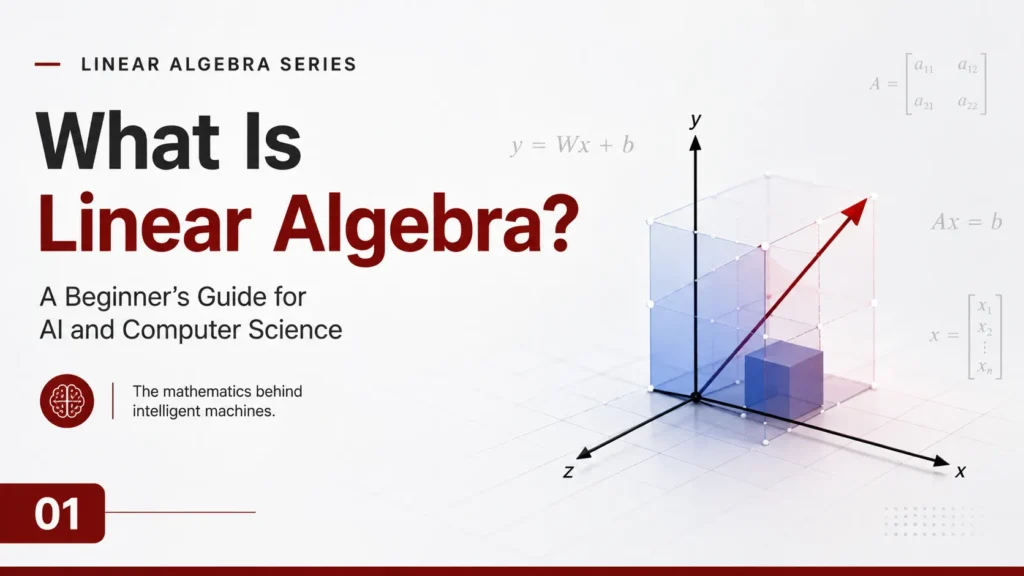
Mathematics is one of the ways we try to make sense of the world around us. We use numbers to measure things, equations to describe relationships, and graphs to understand how things change.
But what happens when the problem becomes much larger?
Imagine working with thousands of images, millions of customer records, the position of objects in a 3D environment, or a dataset containing hundreds of different features. Handling each number separately would quickly become difficult. We need a way to organize this information and work with many quantities at the same time.
This is one of the problems that linear algebra helps us solve.
Linear algebra is a branch of mathematics concerned with quantities, relationships, equations, and transformations. It gives us a way to represent and manipulate information in a structured form.
At first, linear algebra can look like a subject full of symbols, formulas, and unfamiliar terminology. But behind those formulas are some fairly simple ideas: representing information, finding relationships between things, and transforming one representation into another.
Why Does Linear Algebra Matter in Computer Science?
Computers are constantly dealing with information.
A computer game needs to keep track of the position, rotation, and movement of objects. A search engine needs to work with relationships between webpages and pieces of information. A recommendation system needs to compare users and products. A computer vision system needs to process images.
Although these applications look completely different from one another, many of them involve the same underlying problem: How do we represent all this information in a form that a computer can work with?
Linear algebra provides some of the mathematical tools for doing exactly that.
For example, a grayscale image can be represented as a grid of numbers. Each number corresponds to the intensity of a pixel. Once the image has been converted into numbers, a computer can perform mathematical operations on it.
The same idea can be extended much further. Data can be represented mathematically, relationships between different pieces of information can be studied, and transformations can be applied to those representations.
This is why linear algebra appears in areas such as computer graphics, computer vision, data science, machine learning, robotics, and artificial intelligence.
Linear Algebra and Artificial Intelligence
The connection becomes even more interesting when we look at artificial intelligence. Suppose we want to build a machine learning model that predicts the price of a house. We might have information such as its area, number of bedrooms, number of bathrooms, age, and distance from the city.
All of these characteristics can be represented as numbers. Instead of treating them as completely separate pieces of information, we can organize them into a mathematical representation.
For example: x=[1200,3,2,10,5]
This could represent the features of one house.
Now imagine having information about thousands of houses. We can organize all those values together and perform operations on them.
This is where linear algebra becomes particularly useful. It gives us a way to work with large collections of numbers without treating every value as an isolated object. Machine learning algorithms rely heavily on these kinds of operations while learning patterns from data.
What About Neural Networks?
Neural networks provide an even clearer example. A neural network contains parameters called weights. During training, these weights are adjusted as the model learns from data. When there are thousands or millions of weights, we need an efficient way to organize and process them. Matrices and vectors provide one such representation.
A simplified neural network operation can be written as: y=Wx+b
Here, x can represent the input, W represents the weights of a layer, and b represents a bias.
You don’t need to understand this equation yet. We will break down these ideas later in the series. The important thing to notice is that an operation that may look like “AI” from the outside can involve mathematical operations that belong to linear algebra underneath.
This is one reason understanding linear algebra can change the way you look at machine learning. Instead of seeing a neural network as a mysterious collection of code and algorithms, you can begin to understand some of the mathematics taking place inside it.
Linear Algebra Is Also About Geometry
Linear algebra is not only about numbers arranged in tables. It also has a strong connection with geometry. A mathematical object can represent a position or direction in space. We can change its size, move it, rotate it, or transform it in other ways.
For example: [3,2]
can represent a point or a vector in two-dimensional space. Once we start thinking geometrically, some of the operations in linear algebra become much easier to visualize.
Suppose we want to rotate an object in a computer game. Rather than manually changing every point of the object, we can use mathematical transformations to change all of them systematically.
This is one of the reasons linear algebra is so important in computer graphics and 3D computing.
The same mathematical ideas can also appear in other areas. A transformation that changes a set of coordinates in graphics may look very different from a transformation applied to data in machine learning, but the underlying mathematics can be closely related.
So, What Does Linear Algebra Actually Study?
Now that we have seen why the subject matters, we can look at what linear algebra actually deals with.
At its foundation are several important ideas.
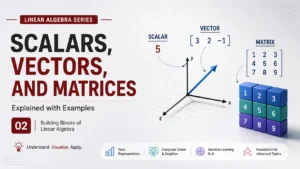
- Scalars are individual numerical values. eg, 10, 7, 9.5
- Vectors allow us to represent several values together and can also represent things such as direction and position.
- Matrices allow us to organize numbers into rows and columns and perform operations on them.
From these basic ideas, we can move toward more advanced concepts such as linear equations, vector spaces, basis, dimension, linear independence, eigenvalues, eigenvectors, linear transformations, and matrix factorization.
These may sound like completely separate topics at first. They are not. They are connected parts of the same mathematical framework. And as we move through this series, we will build those connections step by step.
Why Learn Linear Algebra Instead of Just Using Libraries?
If you’re studying computer science or AI, you might ask a reasonable question: “If libraries like NumPy can perform these calculations for me, why do I need to learn the mathematics?”
You can certainly use a library without knowing all the mathematics behind it. But understanding the mathematics gives you a different level of understanding.
- When you know what matrix multiplication means, you can understand what your code is actually doing.
- When you understand vectors, you can better understand how data is represented.
- When you understand eigenvectors and eigenvalues, concepts such as PCA become much less mysterious.
- And when you understand the mathematics behind machine learning, you are not limited to treating algorithms as black boxes.
You don’t need to become a mathematician before you can build things with AI. But having a strong mathematical foundation can help you understand why those systems work.
Do You Need to Be Good at Mathematics?
Not necessarily. You should be comfortable with basic algebra and arithmetic, but you don’t need to already know advanced mathematics to begin. What matters more is being willing to understand the ideas instead of simply memorizing formulas.
For every concept we encounter, it is worth asking a few simple questions:
- What does this actually mean?
- Why do we need it?
- What is happening mathematically?
- Where would we use it in computer science or AI?
These questions are often more useful than memorizing a formula without understanding what it represents. Once the idea becomes clear, the formula usually becomes much easier to remember.
What Will We Learn in This Series?
I don’t want this series to be a collection of mathematical definitions that you read once and forget. The goal is to build an understanding of linear algebra from the ground up and connect the mathematics with the things we encounter in computer science and AI.
We will begin with the basic building blocks: Scalars → Vectors → Matrices
Then we will learn how to perform operations on them and use them to solve systems of equations.
From there, we will move into: Vector Spaces → Linear Combinations → Span → Basis → Dimension → Linear Independence
Then we will explore some of the more interesting concepts: Eigenvalues → Eigenvectors → Diagonalization → Linear Transformations
Finally, we will look at matrix factorization and practical applications such as: LU decomposition, QR decomposition, SVD, PCA, machine learning, neural networks, computer graphics, PageRank, recommendation systems, and robotics.
Some of these topics will become quite mathematical. Others will focus more on how the ideas are used in real systems. The intention is to connect both sides.
Linear Algebra as a Language
The more I learn about computer science, the more I see mathematics as something beyond calculations for an examination.
- Programming tells a computer what to do.
- Algorithms give us ways to solve problems.
- Mathematics helps us describe the relationships behind those problems.
Linear algebra is particularly useful because it gives us a way to describe and manipulate many quantities together. That makes it extremely valuable when dealing with data, images, simulations, transformations, and machine learning models.
So, I don’t want to think of linear algebra as just another mathematics subject that has to be studied.
I prefer to think of it as one of the mathematical languages behind modern computing.
And now that we understand why it matters, we can start learning the language itself.
What We’ll Learn Next
In the next article, we’ll start with three of the most fundamental ideas in linear algebra: Scalars, Vectors, and Matrices.
We’ll understand what they are, how they are represented, what we can do with them, and where they appear in computer science and AI.