
Articles / Linear Algebra · Part 22
Linear Algebra: The Conclusion | What You’ve Learned and Where to Go Next
A complete journey through Linear Algebra — revisit key concepts, understand how they connect, explore real-world applications, and discover what to learn next.

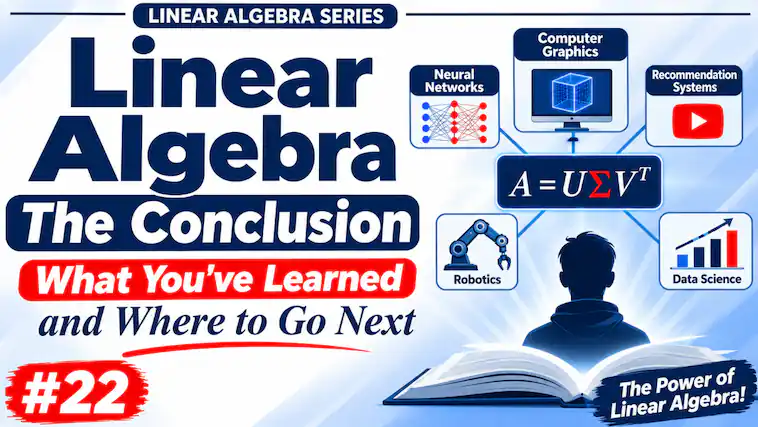
Over the past 21 articles, we have explored Linear Algebra from its fundamental concepts to some of its most powerful applications in computer science, artificial intelligence, and engineering.
We started with simple mathematical objects, scalars, vectors, and matrices, and gradually moved toward vector spaces, eigenvalues, matrix decompositions, and real-world applications.
But the most important thing is not how many formulas you have learned. It is understanding how these concepts connect and how they help us solve problems.
1. Looking Back: What Have We Learned?
Let’s briefly revisit the journey.
Foundations
We began with the basic building blocks of Linear Algebra:
- Scalars represent individual numerical values.
- Vectors represent quantities with multiple components.
- Matrices organize numbers into rows and columns.
We learned how to perform operations such as addition, multiplication, transpose, and dot products.
These operations allow us to manipulate and represent mathematical data efficiently.
Solving Linear Systems
We then explored systems of linear equations and methods for solving them.
We learned about:
- Gaussian elimination
- Row reduction
- Echelon forms
- Determinants
- Matrix inverses
These techniques help us determine solutions to systems of equations and understand when systems have unique solutions, multiple solutions, or no solutions.
Understanding Vector Spaces
Next, we moved beyond simply calculating with vectors and began studying their mathematical structure.
We explored:
- Vector spaces and subspaces
- Linear combinations
- Span
- Basis
- Dimension
- Linear independence
These concepts help us understand how vectors relate to one another, whether certain vectors are redundant, and how a space can be represented using a smaller set of independent vectors.
The Structure of Matrices
We then explored important properties of matrices and linear transformations.
We studied:
- Rank
- Null space
- Column space
- Row space
- Rank-Nullity Theorem
- Eigenvalues and eigenvectors
- Characteristic polynomials
- Diagonalization
These concepts reveal information about the structure of a matrix, the transformations it represents, and the behavior of the systems associated with it.
Advanced Techniques
Finally, we explored powerful matrix decomposition techniques:
- LU Decomposition
- QR Decomposition
- Singular Value Decomposition (SVD)
These techniques allow us to solve systems efficiently, approximate data, reduce dimensionality, and extract meaningful mathematical structure.
2. How Everything Connects
Linear Algebra is not a collection of unrelated topics. Each concept builds upon the previous ones.
Vectors represent data and quantities.
Matrices organize vectors and represent transformations.
Matrix operations allow us to manipulate these representations.
Vector spaces provide the mathematical structure in which vectors exist.
Linear independence, span, basis, and dimension help us understand the structure of these spaces.
Rank and nullity reveal the behavior of transformations.
Eigenvalues and eigenvectors identify important directions that remain unchanged in direction under a transformation.
Matrix decompositions reveal hidden structures and make complex computations easier.
Together, these ideas form a powerful framework for understanding mathematical systems.
3. The Big Picture: Linear Algebra Is About Structure
One of the most important lessons of Linear Algebra is that complex problems can often be understood by identifying their underlying structure.
Consider a large dataset.
Instead of treating every value independently, we can represent the data using matrices, identify relationships between features, discover patterns, and reduce unnecessary dimensions.
Consider a complex transformation.
Instead of studying it directly, we may decompose it into simpler transformations.
Consider a system of equations.
Instead of solving every equation independently, we can represent the entire system as a matrix and apply systematic methods.
This ability to represent, simplify, and analyze complex systems is one of the reasons Linear Algebra is so useful across mathematics and computer science.
4. Where Linear Algebra Is Used
The concepts we studied appear in many technologies.
| Field | Application |
|---|---|
| Artificial Intelligence | Neural networks and model computations |
| Data Science | Data representation and dimensionality reduction |
| Computer Graphics | Rotation, scaling, and transformations |
| Robotics | Position, movement, and coordinate transformations |
| Computer Vision | Image processing and object recognition |
| Recommendation Systems | Discovering patterns in user preferences |
| Physics | Modeling physical systems |
| Engineering | Solving systems and analyzing structures |
Linear Algebra is not merely a prerequisite that we complete and forget. It continues to appear as we study more advanced subjects.
5. Where Should You Go Next?
If you have completed this series and want to continue learning mathematics for computer science and AI, these are some important subjects to explore.
Calculus
Calculus studies change.
It introduces derivatives, integrals, limits, and optimization.
It becomes essential when studying how machine learning models learn, how functions behave, and how systems change.
Probability and Statistics
Probability helps us understand uncertainty.
Statistics helps us analyze data, make conclusions, and evaluate models.
These subjects are fundamental to machine learning, data science, and scientific research.
Optimization
Optimization is the study of finding the best solution under certain conditions.
It is especially important in machine learning, where algorithms attempt to minimize errors or maximize performance.
Machine Learning
Machine learning combines mathematics, programming, statistics, and algorithms to build systems that learn patterns from data.
Linear Algebra plays a central role in representing data, performing computations, and understanding many machine learning algorithms.
Deep Learning
Deep learning extends machine learning through neural networks with multiple layers.
It combines Linear Algebra, calculus, optimization, probability, and computational techniques to solve complex problems involving images, text, speech, and other forms of data.
6. What Should You Do With What You’ve Learned?
Reading mathematics is only the beginning.
To develop a strong understanding:
- Solve problems without looking at solutions.
- Implement mathematical operations using Python.
- Visualize vectors, transformations, and matrices.
- Experiment with NumPy.
- Apply concepts to small real-world projects.
- Revisit difficult concepts instead of memorizing formulas.
For example, you could write a Python program that performs matrix multiplication, implement Gaussian elimination, visualize eigenvectors, or build a simple recommendation system using matrix factorization.
The moment you start implementing these ideas, mathematics becomes much more concrete.
7. A Final Message
Linear Algebra may initially seem like a subject full of symbols, equations, and abstract definitions.
But behind those symbols lies a way of understanding the world.
It teaches us how to represent information, recognize relationships, identify patterns, simplify complexity, and approach problems systematically.
You don’t need to remember every formula forever. What matters is developing the ability to understand a problem mathematically, identify the concepts that apply, and work toward a solution.
The 21 articles before this one were designed to build that foundation.
Now, the next step is yours: practice, experiment, build, and continue learning.
The end of this series is not the end of your mathematical journey. It is the beginning of being able to use mathematics.
Originally published at farhanpaal.com — https://farhanpaal.com/articles/linear-algebra-the-conclusion-what-youve-learned-and-where-to-go-next/
Keep a copy
Read offline as a printout or PDF.
farhanpaal.comKeep reading

Matrix Factorization: LU Decomposition for Solving Systems
Learn LU decomposition, factor matrices into lower and upper triangular forms, and solve systems of linear equations using forward and backward substitution.
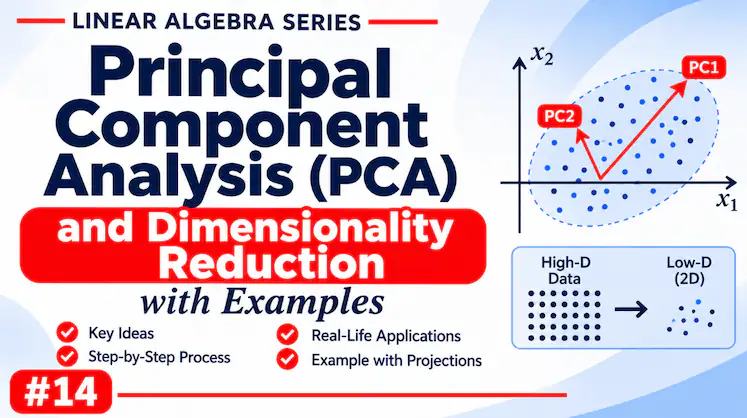
Introduction to Principal Component Analysis (PCA) and Dimensionality Reduction
Understand Principal Component Analysis (PCA), dimensionality reduction, eigenvectors, and eigenvalues. Learn how PCA identifies important directions in data, reduces features, and preserves…
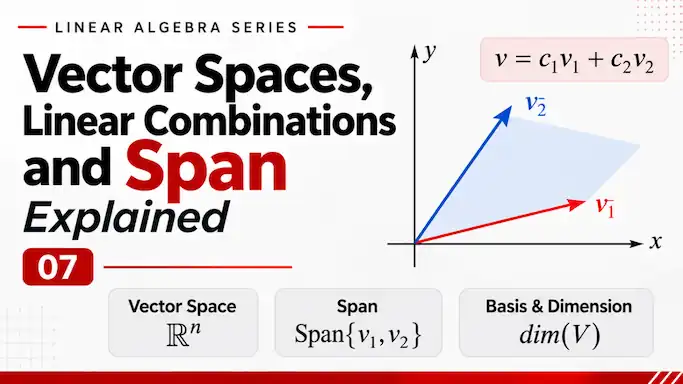
Vector Spaces, Linear Combinations and Span Explained
Learn what vector spaces, linear combinations, and span mean in linear algebra, with clear examples, geometric explanations, and applications in AI.