
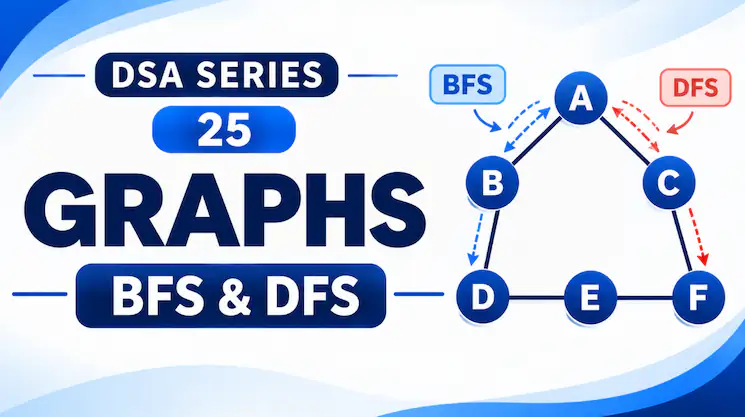
Graphs: Terminology, Representations, and Traversal Techniques (BFS & DFS)
Learn what graphs are, how they are represented using adjacency matrices and lists, and how BFS and DFS traverse graphs.
Articles · Category
This series covers the fundamentals of Data Structures and Algorithms, from arrays, linked lists, stacks, and queues to trees, graphs, sorting, searching, and problem-solving techniques. It focuses on understanding how data is organized and how algorithms work efficiently to solve computational problems.
30 articles
Learn what graphs are, how they are represented using adjacency matrices and lists, and how BFS and DFS traverse graphs.
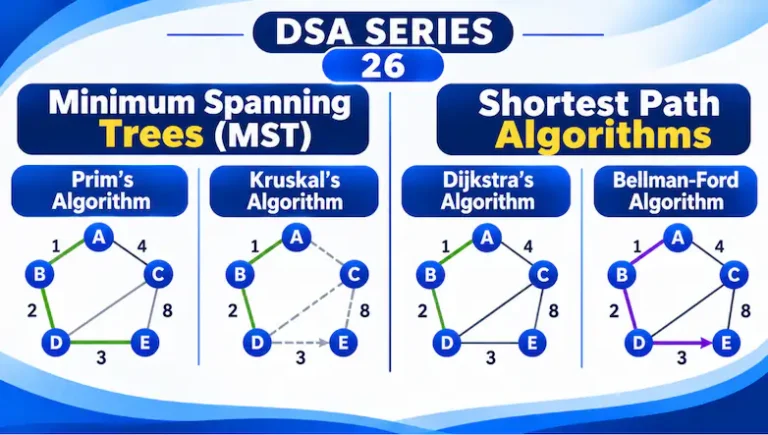
Learn how Prim's, Kruskal's, Dijkstra's, and Bellman-Ford algorithms solve minimum spanning tree and shortest path problems.
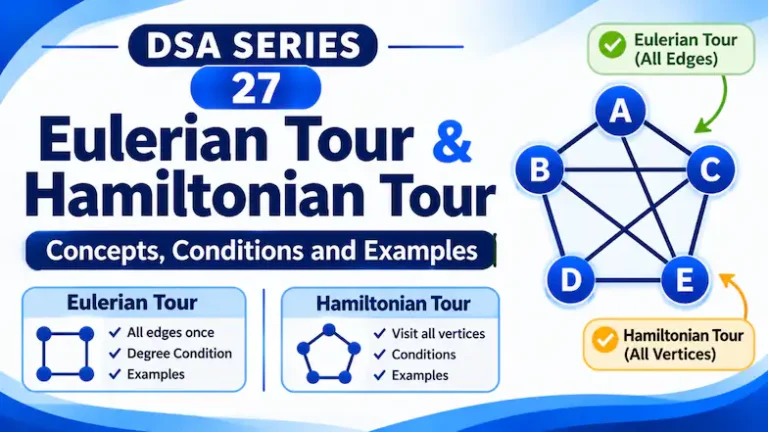
Understand Eulerian and Hamiltonian paths and tours, their conditions, differences, examples, and real-world applications in graph theory.
Learn hashing, direct address tables, hash functions, collisions, and load factor with simple examples and understand how hash tables enable fast data…
Learn how hash-table collisions are resolved using Separate Chaining, Linear Probing, Quadratic Probing, and Double Hashing, and how Rehashing improves performance.
Conclude your DSA journey with key lessons from 30 articles, the importance of practice, problem-solving, and what to learn next.